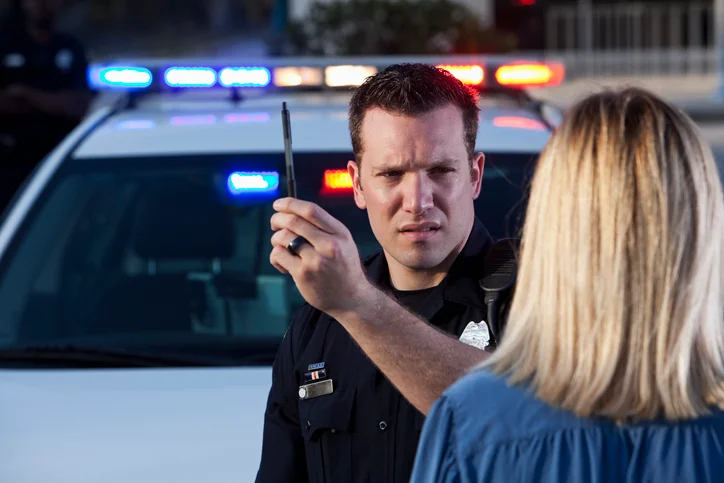
Imagine driving down a Florida highway, feeling confident and relaxed behind the wheel, when suddenly you see flashing red and blue lights in your rear-view mirror.
Your heart races as you realize you’re being pulled over and the possibility of being charged with a DUI becomes a reality – especially since you just had a few drinks with friends.
In Florida, DUI traffic stops are becoming increasingly common. In 2022, 44,001 Florida drivers were caught with a blood alcohol concentration above 0.08%, the state’s legal limit.
A common question that often arises during a DUI traffic stop is, “can you refuse a field sobriety test in Florida if asked to take one by a law enforcement officer?”
In this blog, West Palm Beach DUI attorney Ronald S. Chapman will answer this question and share what you need to know. If you are facing the consequences of a refusal and a DUI charge, don’t hesitate to contact us at (561) 832-4348, so we can begin to fight for you.
The Basics of Field Sobriety Tests
What Are Field Sobriety Tests and How Do They Work?
Field sobriety tests are a series of physical and mental exercises law enforcement officers use to determine if a driver is impaired by alcohol or drugs. These tests are designed to evaluate a person's balance, coordination, and cognitive abilities, which can be affected by substance use.Common Types of Field Sobriety Tests
Law enforcement officers commonly use three standardized field sobriety tests in the United States:- Horizontal Gaze Nystagmus Test: The Horizontal Gaze Nystagmus Test involves the officer having the driver follow a moving object, typically a pen or finger, with their eyes and watching for involuntary jerking of the eyes, known as nystagmus.
The officer will also check for equal pupil size, resting nystagmus, and equal tracking. Any involuntary jerking could indicate alcohol or drug impairment to the officer. If the driver fails this test, it may be used as evidence in court that they were under the influence while driving.
- Walk-and-Turn Test: The Walk-and-Turn Test is a test that requires the driver to walk a straight line, heel-to-toe, for nine steps. The officer then instructs the driver to turn around and walk back in the same manner.
During this test, the officer looks for the driver to fail to complete the test correctly, such as by not walking heel-to-toe, not keeping their arms at their sides, not looking down at their feet, or failing to turn correctly.
- One-Leg Stand Test: The One-Leg Stand Test is a test that requires the driver to stand on one leg for a predetermined time, usually 30 seconds.
During this test, the officer looks for the driver to fail to complete it correctly, such as by not standing on one leg, hopping, or putting their foot down.
Accuracy of Field Sobriety Tests
According to research conducted by the National Highway Traffic Safety Administration, the accuracy of field sobriety tests varies depending on the test. The horizontal gaze nystagmus test has an estimated accuracy rate of 77%, while the walk-and-turn test and one-leg stand test have an accuracy rate of 68% and 65%, respectively. When all three tests are performed together, their combined accuracy rate stands at 82%.These results show that field sobriety tests are far from perfect when determining if someone is under the influence of alcohol or drugs. Even sober drivers can fail these tests due to medical conditions and physical impairments such as poor balance or vision problems.
Understanding Reasonable Suspicion and Implied Consent
Reasonable Suspicion
Before an officer can administer a field sobriety test, they must have reasonable suspicion that you are impaired. This means they must have a valid reason to suspect impairment, such as erratic driving, the smell of alcohol, or slurred speech.If the only basis for the stop is a minor traffic violation, like a broken taillight, with no other signs of impairment, the officer might not have reasonable suspicion.
In such cases, you may have grounds for challenging any test results or the legality of the stop in court if you believe the officer did not have a valid reason to suspect impairment.
Implied Consent
While there must be reasonable suspicion for an officer to administer field sobriety tests, it's also important to understand how reasonable suspicion relates to Florida's implied consent law.Florida operates under an “implied consent” law. When you obtain a driver’s license and drive on public roads, you implicitly agree to submit to chemical testing (breath, blood, or urine) if an officer has reasonable suspicion you are under the influence of alcohol or drugs.
However, this law does not apply to field sobriety tests as they are considered observational assessments of a driver’s impairment, while chemical tests provide more concrete evidence by measuring blood alcohol concentration or detecting the presence of drugs.
Should You Refuse a Field Sobriety Test?
In Florida, no law requires a Florida driver to submit to field sobriety tests if pulled over on suspicion of DUI. However, it is generally recommended by experienced criminal defense and DUI attorneys to politely decline field sobriety tests, as these tests often do more harm than good in court proceedings.In contrast, refusing a chemical test will result in immediate penalties, including a one-year driver’s license suspension for a first offense. You will also potentially face enhanced DUI penalties if you’re later found guilty of DUI.
Even though refusing a field sobriety test is not illegal, there can be consequences for refusing, depending on your circumstances.
Potential Consequences
For example, the officer may view the refusal as suspicious behavior and use it as a basis for reasonable suspicion to administer a chemical test. Additionally, if the case goes to court, the prosecution may argue that you refused the field sobriety test because you knew you were under the influence, which could be used as evidence against you.Reasons Drivers Choose to Submit to Field Sobriety Tests
There are several reasons why a driver might decide to submit to a field sobriety test during a DUI traffic stop. Some of these reasons include:- Cooperation. A driver may submit to a field sobriety test to demonstrate cooperation with law enforcement officers. Complying with the officer's request may be viewed as a sign of good faith, potentially leading to a more favorable outcome during the encounter.
- Confidence in Sobriety. If the driver is confident they are not impaired and can successfully pass the field sobriety test, they may take it to quickly alleviate the officer's suspicions and potentially avoid further investigation or arrest.
- Lack of Knowledge. Some drivers may not be aware of their right to refuse a field sobriety test and may submit to it simply because they think it is required by law. In such cases, drivers might not know they can decline the test.
- Fear of Consequences. Although refusing a field sobriety test is not illegal, some drivers may worry about potential negative consequences, such as increased suspicion or even arrest, if they refuse to take the test. They may believe submitting to the test is the best way to avoid escalating the situation.
- Perception of Fairness. Some drivers may believe that the field sobriety tests are a fair and objective way to determine impairment and may feel that submitting to the test will help prove their innocence.
Did Your Refusal of a Field Sobriety Test Lead to a DUI Charge? Contact a West Palm Beach DUI Attorney Today
If you or a loved one has been charged with a DUI in Florida, it is crucial to seek the advice of an experienced attorney as soon as possible. West Palm Beach DUI attorney Ronald S. Chapman, P.A. has over 34 years of experience defending clients against DUI charges and is committed to providing the best possible defense for your case.Remember, time is of the essence when it comes to DUI charges due to strick deadlines, so don’t hesitate to reach out for help today. Contact our office at (561) 832-4348 to schedule a meeting and discuss your legal options, so we can begin to fight for you.